



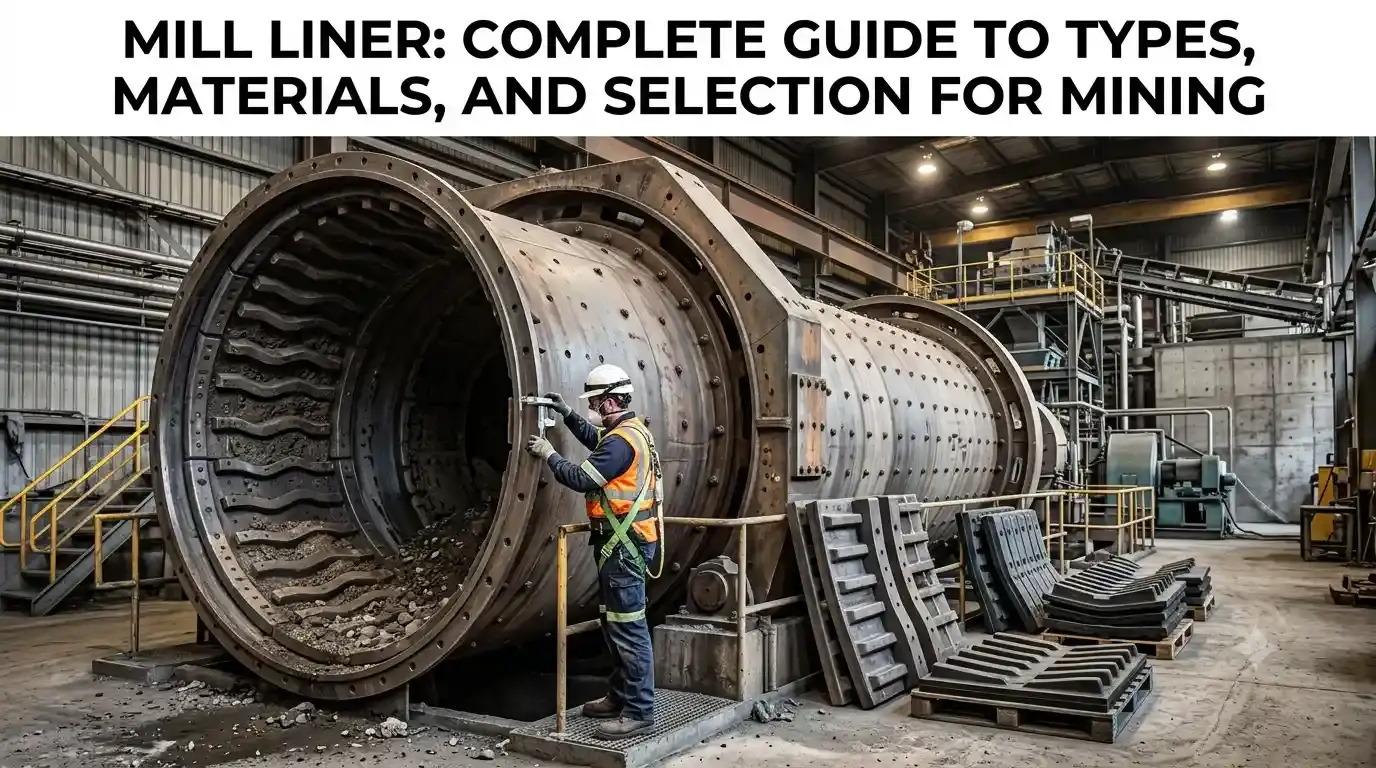
A grinding mill is used in mining operations for round-the-clock operations. They crush and grind ore to reduce it to smaller particles and extract valuable minerals. These mills grind the ore and the grinding media with great force, causing crushing and attrition of the walls of the mills. A mill liner comes in handy for that. They help preserve the mill shell, increase grinding efficiency, and directly affect your operation's productivity. Here you will find the information you need regarding mill liners.
A mill liner is a material used to protect the interior of a grinding mill. It is placed between the mill shell and the ore and other grinding materials such as steel balls or rods. The liner helps prevent the mill shell from experiencing shocks and impacts that could cause damage.
But mill liners do more than protect. They are designed and profiled to affect the grinding media movement in the mill. This impacts both the grinding efficiency and energy utilization, as well as the size of the finished ground product. The well-designed liner increases liner speed and lowers operating cost. A bad design causes increased wear, lower efficiency, and more maintenance downtime.
There are several types of mill liners based on mill design and grinding application.
The cylindrical body of the mill is lined with shells. The most popular and least protected ones are the most abused during operation. The flat, wave, or high-low profile design of the profile determines the lifting action of the grinding charge and therefore plays a significant role in the breakdown of ore.
Headliners are used to protect the mill's end walls, called heads. They generate less impact than shell liners but need long-lasting protection. They are frequently curved or even conical, resembling a mill head.
They are used in grate-discharge mills and have openings that allow ground material to pass while trapping the grinding media within the mill. The grate opening design determines the particle size leaving the mill and the amount of media inside the mill.
Lifter bars are raised pieces installed in the space between a shell liner plate. Their function is to raise the grinding media and ore to a certain height, then drop them onto the ore below. The height, angle, and spacing of the lifter bars directly influence impact energy and grinding efficiency. The correct lifter bar profile is an important key to mill performance.
One of the key choices when specifying a mill liner is the selection of materials. The selection of the right material depends on the nature of the mill, ore properties, and grinding conditions.
The standard material used for the mill liners is steel. Commonly used are manganese steel, chrome-moly steel, and high chrome steel. Manganese steel work-hardens under impact, making the surface harder with each impact. Hence, it is suitable for use in mills that process highly abrasive ores. Chrome-Moly steel has good toughness and wear resistance. When abrasion resistance is most critical, high chrome steel is used.
Over the decades, rubber linings have grown in popularity. They weigh less than steel, lessening the load on the mill bearings and accelerating the installation and replacement. Rubber dissipates impact energy rather than resisting it, thereby minimizing noise. They are suitable for use in mills with finer grinding and lower impacts. Rubbers are not recommended for coarse grinding or for very high-temperature use.
The composite liners use an insert of rubber, steel, or ceramic. These are made from rubber and are cushioned and lightweight, with steel or ceramic in the areas most likely to wear out. This combination offers the advantages of both materials. In semi-autogenous grinding mills where both impact and abrasion are important, the usage of composite liners has become popular.
Where metal wear causes would be considered contaminating, ceramic liners can be used. Certain specialty mineral processing, food processing, and pharmaceutical companies also employ ceramic liners to prevent contamination of the ground product by metallic materials. They are firmer and more brittle than steel or rubber, and would not be suitable for heavy grinding.
If you understand wear, you can maximize the life of your liners and operate your equipment more cost-effectively.
Liners are less durable when hard or abrasive ores are used. One of the important parameters for ore specification is the Bond abrasion index number. Harder, more wear-resistant liner materials are required when processing highly abrasive ores, such as silica-rich ores.
The larger the grinding balls, the higher the impact force. This increases wear on the lifter bars and the liner surface. The size and hardness of the grinding media should be matched to the hardness of the liner material to prevent premature failure caused by impact fracture of the liner.
The mill speed is given as a percentage of the critical speed. A mill operating at too high a speed will experience higher impact forces on the liners, causing wear. If it runs too slowly, grinding efficiency will decrease. The optimization speed of the used liner profile is part of achieving the best performance from either.
There must be a systematic approach to selecting the correct mill liner. There is no single type or material that is ideal for all applications. Several factors need to be considered.
• Begins from the properties of the ore. Be familiar with the hardness, abrasiveness, and particle size of the feed material. This reduces the available materials and allows you to choose a liner toughness and wear resistance profile.
• Consider the mill type and size. Ball mills, rod mills, SAG mills, and autogenous mills are different in their operating conditions and liner requirements. Liners are needed that can withstand higher impact energy from larger grinding media for larger mills.
• Review a maintenance plan. Mill downtime is needed for liner replacement. An appropriately sized liner for your turnaround can help minimize unplanned downtime. If downtime is undesirable, some operations opt for a longer service life at a higher cost.
• Collaborate with your liner supplier to create liner profiles. The efficiency of the mill depends as much on the shape of the lining surface as on the nature of the material, such as the lifter bar angle and height. The supplier's simulation tools can predict the performance of various profiles for your specific mill before creating the physical liner.
Yes, in most cases. Premium liners are more expensive initially but result in a lower total operating cost. They have a longer service life and lower downtime, enhance grinding efficiency, and reduce energy consumption per ton of ore ground. Savings in energy, maintenance labor, and lost production from liner changes are generally significantly greater than the cost of buying a quality liner.
Frequent shutdowns are caused by cheap liners that wear out rapidly. For each shutdown, there is lost production time and change-out labor. The price point for frequent liner changes with budget liners typically exceeds that of quality liners, which last much longer throughout the year.
Mill liner is an important element in every milling process. The appropriate type, material, and profile for the application will directly impact productivity, energy use, and maintenance costs. To select a liner, take some time to learn about your ore, your mill, and your goals and objectives. The best option is the one that gives you the most money back for your performance and uptime.
1- What are the options for buying mill liners in Bulk for a retail business?
Purchase directly from mill linen manufacturers in South Africa and China via Alibaba and Global Sources B2B platforms. Always check the specifications for materials, export documentation, and wear resistance ratings before placing any bulk order.
2- How to Purchase Mill Liners in wholesale at Economic Prices?
Talk directly to mill liner manufacturers and eliminate the middleman for factory-level pricing for bulk orders.
3- Where Can I Find a Mill Liner Supplier Who Also Offers Customization?
The majority of Chinese and Australian mill liner suppliers can customize the profile, lifter bar design, material grades, or composite configuration according to different mill types and ore characteristics.
4- What should I check when deciding on an appropriate mill liner supplier?
Double-check material certifications from the supplier, inquire about the wear life history of other similar mining operations, and seek references from existing clients.
Every day, ball mills do hard work. Liners in each mill ensure that the shell is not damaged by c
READ FULLOne overlooked factor in
READ FULL
Have a question or need a quote? Fill out this form and our team will get back to you quickly!