



Ball mills have to perform heavy-duty operations, and each component has to be excellent in performance. The material has to meet every requirement of the machine to survive massive operations like grinding of various solid particles. These particles differ in size and strength, which is why the liners inside these mills have to be really durable to support the process. Industrial buyers have to look for such ball mill liners in bulk for consistent performance in regular operations. Here is a guide for such buyers who want ease in the selection process.
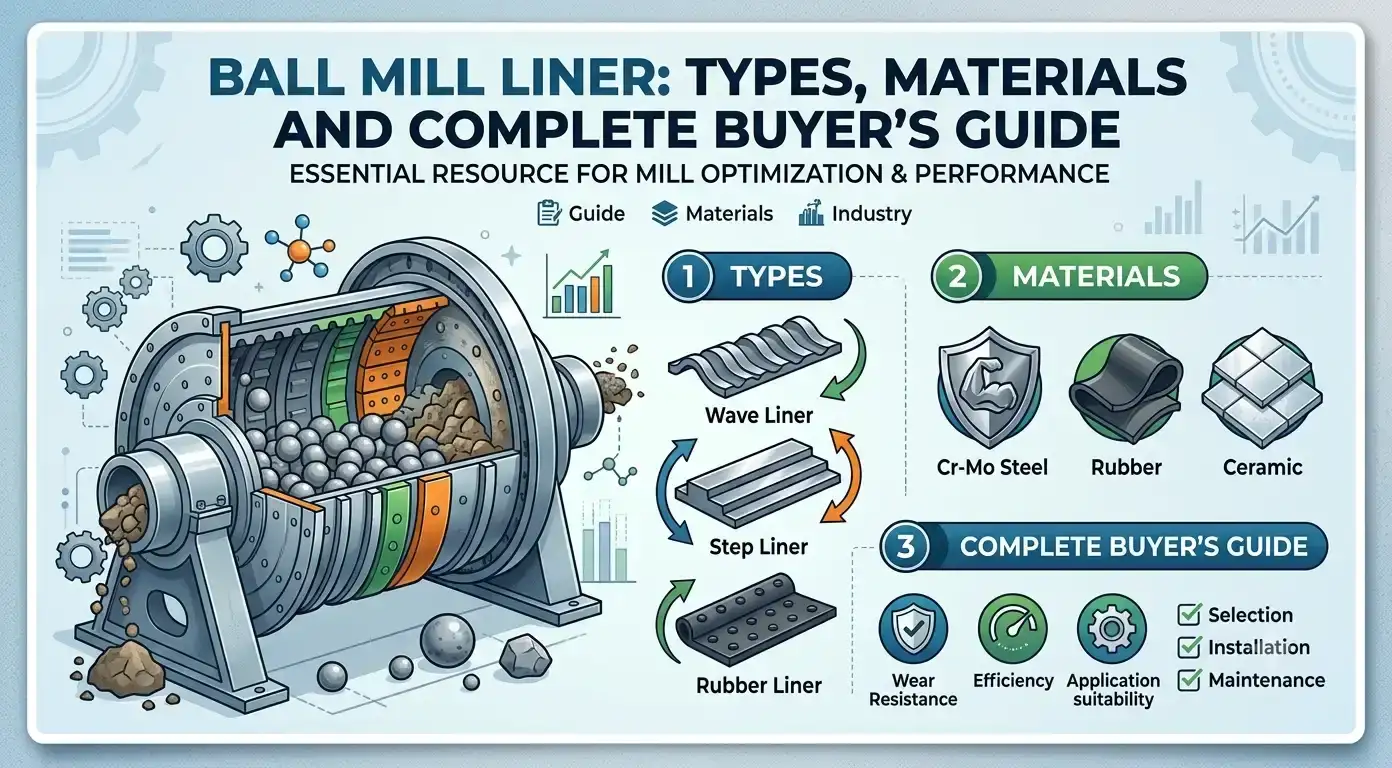
There are around ten types of ball mill liners. These types have different shapes from each other, and each shape performs differently. When the grinding balls make contact with them, the results vary because of these shapes. Each ball mill liner’s shape can provide a different result, and selection requires complete information. Here are some types for you that can help you understand how they affect the performance.
It is suitable for progressive grinding, which is why its name is a step-shape ball mill liner. This shape faces less impact from the balls because it focuses on gradual impact. This gradual impact on liners reduces the cost of frequent replacement, and their durability is longer.
These mill liners have wave shapes. They provide balanced support in the grinding process through this wave shape. These liners are suitable for the basic grinding process. It is also suitable for equal impact, which comes through the wave pattern.
Wedge shape reduces bolt stress on the liners. This is why it is suitable for wedge-bolted liner mills. They face less vibration in the grinding process. Since they are compatible with wedge-bolted liner mills, they make a durable choice in those specific conditions.
The flat shape of mill liners is suitable for the fine grinding process. There are many operations where fine grinding is the utmost need, and flat-shape mill liners provide balanced results. Due to their shape, they are easy to install in the mills. Due to the same reason, they face less wear and tear in the mills during the grinding process.
Then a similar shape is here that is suitable for a smooth and uniform grinding process. This shape also provides even wear and tear. As a result, the durability is longer since all the liners get balanced impacts. Besides, there is less risk of turbulence in plane-shaped mill liners. These liners can also perform well against aggressive grinding.
Then the last one is a strip shape, which is suitable for coarse grinding. This shape is a suitable choice for high-impact grinding operations. Also, it is a cost-effective option, which helps mills to control their maintenance cost.
There are four main materials that are common in the ball mill liner production. These materials show different compatibility levels depending on each condition. They are chromium steel, manganese steel, rubber, and composite. You will find their pros and cons in the following section to understand better.
Chromium steel ball mill liners contain high chromium. It makes them excellent corrosion-resistant liners. As a result, they can withstand wet grinding operations without risk of corrosion. Also, they are better than others when it comes to abrasion resistance. Their durability is long, and they can survive most threats.
However, they can not face high-impact applications because they are more brittle than others. Their high chromium makes them prone to cracking in extreme impacts. Also, they are costlier than others, whether it is their price or maintenance cost.
Overall, they are suitable for large-ball grinding operations where the risk of wear and tear is high. They are easy to install and replace in the mills compared to manganese types.
Manganese steel ball mill liners are compatible in their domain. They can withstand impacts better than chrome types. Also, they harden over time to improve their performance against high-impact applications.
Their price is less than the chrome type, and they are cost-effective in replacement. However, they require more replacement than the chrome type. Besides, they resist cracking to show good durability. Their replacement is not easy, and they require welding for a better solution.
Then comes a combination of alloy steel and rubber. It gives the benefits of metal and rubber mill liners together. Also, it is a cost-effective solution compared to metal liners. Besides, it is suitable for impact resistance and abrasive resistance because of its flexibility.
Installing them is easier than steel liners because they are lightweight and cost-effective. Even the replacement process is easy and cost-effective. In applications where the impacts and abrasions are low, composite liners are more suitable.
Then there are rubber ball mill liners, which are flexible, lightweight, and also cost-effective. They withstand wear, impact, and corrosion together. They are suitable for milling where fewer impacts are required. Also, they are compatible with wet grinding since they are non-metallic liners. They are easy to install and replace, and the cost of both is the lowest.
There are some secondary factors that you need to consider. It is also about the size of mills and grinding balls that affect the performance and compatibility of liners. Grinding rate, maintenance cost, price, and lots of other factors are involved in the process. The following are the details you need to look at.
The size of the mill depends on the type of grinding process and the product being ground. That is why the selection of ball size and the liners matters a lot. Large mills and large grinding balls require steel liners for the best performance. Rubber and composite liners can not perform well in them. Small balls are good with rubber and composite liners where one does not need much pressure.
Then comes the grinding rate, where chromium steel mill liners provide the best grinding results. They have high abrasion resistance that makes them withstand high wear and tear at a powerful grinding rate. If the grinding rate is low, one can use rubber or composite ball mill liners.
In wet grinding, rubber or chromium ball mill liners are more suitable. They are corrosion-resistant materials, which is why they can survive these conditions. If the grinding is dry, any material will be compatible.
The price and maintenance cost depend on the type of material used in ball mill liners. Industries have to choose them as per their requirements, budget, and durability factors. Here are some highlights that can help you understand the price and maintenance factors between all these materials.
• Chromium liners are expensive, non-weldable, and easy to replace.
• Magnesium liners are less expensive, weldable, and hard to replace.
• Composite liners are less expensive than metal liners, non-weldable, and easy to replace.
• Rubber liners are the cheapest, easy to replace, and non-weldable.
The last comparison is maintenance difficulty. Chromium, composite, and rubber liners are easy to install compared to manganese liners.
When you are about to search for a supplier of ball mill liners, you will have to search for a reliable name. That supplier must be a certified, affordable, and experienced name in the industry. You can find such suppliers on B2B platforms easily. However, you can try Ningguo Ningwu Advanced Material Co., Ltd. It is a bulk manufacturer that may meet your requirements. The only way to find its reliability and efficiency is by contacting it.
Ball mill liner selection requires a deep analysis. It is not just a random selection of even a few hours of analysis. It is all about a complete analysis that makes a buyer look into every detail, like material type, cost, performance, durability, and the list goes on. One of the ways to get assistance in the selection process is via a guide. You can try the above guide that we provided. It will surely help you select the kind of ball mill liners your application requires.
Every day, ball mills do hard work. Liners in each mill ensure that the shell is not damaged by c
READ FULLOne overlooked factor in
READ FULL

Have a question or need a quote? Fill out this form and our team will get back to you quickly!