



One overlooked factor in ball mill performance is liner thickness. When buying, several factors are considered, such as material grade or profile shape, but thickness is just as important. This article describes the role of liner thickness in grinding efficiency, wear life, and mill availability.
Maintaining this balance can have a great effect on productivity and maintenance expenses throughout the life of a mill. Operators and decision-makers are better informed today about how to reconcile their needs over time.
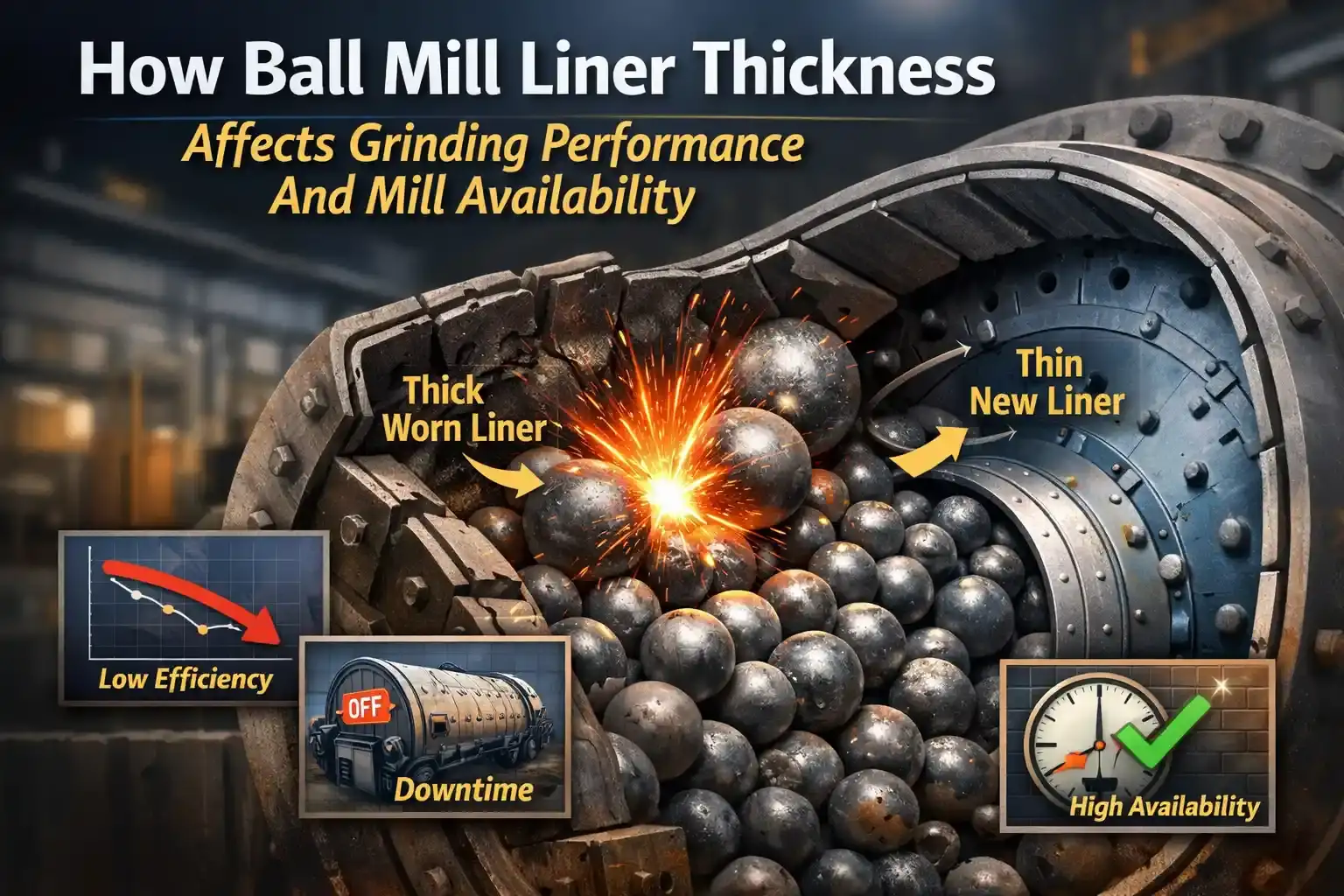
Liner thickness affects the liner's longevity under impact and abrasion. Thicker liners will last longer but will reduce the internal mill volume. This means that a trade-off must be maintained between wear life and grinding efficiency, which operators need to manage. The wrong thickness can result in either early liner failure or reduced grinding capacity. Both impact productivity and operational costs in the long run.
Each millimeter of liner thickness reduces the available volume for the grinding balls and the material. This directly affects how much material will pass through a mill in a single operating cycle.
Adjusting thickness and capacity
Thicker liners use more of the mill shell's interior, resulting in less grinding charge. This can shorten the liner's overall life, even though the liner itself has a longer life. It is crucial to strike the right balance to achieve regular output.
The trade-off becomes more evident in small mills, which will significantly impact grinding capacity when internal volume is lost with every millimeter, compared with larger industrial mills.
Thicker liners will provide a longer lifespan, as they take longer to break down before they are too thin to use. This decreases the frequency of liner replacement, which, in turn, significantly decreases the maintenance frequency.
Tradeoffs of Added Thickness
There are costs to this benefit. Thicker liners make the mill heavier, which can affect the machine's rotational balance and energy consumption. These should be considered by buyers in line with their grinding demands.
The grinding efficiency of the mill relies on the effectiveness of the grinding balls' interaction with the material placed in the mill. Thicker liners may reduce ball-charge swing in the mill, which can negatively affect grinding efficiency in some mill designs. Thinner liners provide greater volume for grinding media and material. This can lead to higher initial throughput but will result in a shorter liner lifespan and increased future downtime for replacement.
Thinner liners can be more economical for a high-volume operator, but with less wear life, the higher daily volume and less restriction during operation can even out the cost.
Mill availability indicates the proportion of time that the mill is operating actively versus inactively for maintenance. The liner thickness will directly influence how often a mill needs to stop for liner changes.
Thickness and Downtime Frequency
Thicker liners can be replaced less frequently, putting the mill in production for longer. Thinner liners may require more frequent shutdowns, as short-term throughput may increase, but a lower-thickness liner may not be available as often.
There are many factors involved when choosing the liner thickness, and optimal weightings for thickness need to be determined. There is no standard thickness for all operations.
Several factors determine the thickness.
This is mainly influenced by ore abrasiveness. Thicker liners are often required for harder, more abrasive ores. Thinner liners might work well for softer ore types, maximizing internal mill volume and throughput. The optimum thickness will also be affected by mill speed and ball size. A thicker lining to maintain a safe and durable operating margin may be necessary at higher mill speeds and with larger grinding balls.
Frequent liner checks allow for more accurate schedule estimates and prediction of liner wear and tear patterns. This information is also used to assess if the current liner thickness is suitable for the mill condition.
Good tracking of wear rates across several liner change-out cycles can help determine future liner thickness. This enables operators to more effectively tailor their liner strategies to real-life conditions, rather than relying on underestimates.
Some operations employ ultrasonic thickness gages to determine the thickness of the remaining liner material but do not require stopping the operation for a complete inspection. This technology can enable more accurate replacement programming, free from needless downtime.
Liner replacement involves a complete shutdown of the mill, thus impacting production. An operator's knowledge of these costs will enable them to assess the value of their choice of liner thickness in their particular situation.
Planning Replacement Schedules
In order to minimize downtime, liner changes are scheduled to occur during the maintenance periods. Thicker liners that are consistent with practical maintenance regimes can have a positive influence on increased availability throughout the year.
How to know which liner thickness to select?
Each particular ore type, the production targets, and the maintenance schedule of the purchaser should determine the liner thickness. Talking to liner manufacturers familiar with these factors helps determine which liner will optimize long-term performance. Many manufacturers offer testing to compare product thicknesses before replacing all liners within the mill.
Choosing the liner thickness based on upfront cost may be misleading. High-quality, thicker liners tend to be more expensive up front but can save on replacement costs and downtime later.
The true value is determined by cost per ton processed and not cost per liner. It enables dealers to make a decision based on operational efficiency over the long term rather than just on price. These statistics can also be analyzed across multiple liner cycles, which will not be apparent from a one-off purchase. This information is valuable for future contract negotiations or when considering new liner suppliers.
Thickness is one of the factors that determine overall performance, along with material quality. A thick liner of lesser quality material may not last as long in some operating situations as a thinner liner of higher quality alloy steel.
When shopping, buyers must take both into account and not just thickness. The manufacturer, with a strong background in materials science, may find a way to combine them in a way that aligns with the grinding process. It is always best to test different thickness and material combinations under actual service conditions and then select the most cost-effective option for each to ensure you can improve the system as much as possible.
Many liner manufacturers will deal with varying thicknesses depending on mill conditions and production objectives. This allows the operator to customize the chosen liner, not just the options available in the industry. Discuss ore characteristics, production goals, and maintenance needs with manufacturers to identify suitable thickness options that optimize grinding performance and mill availability over the long term.
Some manufacturers also provide different thicknesses across the set of liners, with thicker areas in the high-wear section and lighter areas elsewhere to maintain the internal mill volume. This focused approach may provide the best of both worlds for some operations:
Liner thickness is an important variable to ensure good grinding efficiency, wear life, and mill availability. Thinner liners are often more productive; thicker liners are usually more durable and available. With the information on production goals, maintenance plans, and your ore type, you will be able to carefully choose the thickness for optimal long-term production.
1- What is the best place to purchase ball mill liners in bulk in order to have a retail enterprise?
Purchase from a manufacturer who accepts bulk quantities. This typically translates to solid prices and uniform product quality for bulk orders.
2- How to buy ball mill liners wholesale at affordable rates?
Research several manufacturers and inquire about the different price levels for wholesale. Higher order quantities usually result in lower unit costs.
3- Where to find the ball mill liner supplier who provides customization services?
Check out manufacturers who have in-house engineering and casting departments. Many provide custom liners according to the mill size, ore type, and thickness demand.
4- Is there any ball mill liner supplier who offers bulk supply with customization at low prices?
Yes, there are some manufacturers who provide bulk pricing in addition to providing customization services. Contact suppliers directly to discuss specific project requirements.
5- What is the best timing for reevaluating ball mill liner thickness?
Thickness suitability should be re-evaluated when there is a significant change in ore type, production goals, or maintenance schedules at an operation.
Every day, ball mills do hard work. Liners in each mill ensure that the shell is not damaged by c
READ FULLOne overlooked factor in
READ FULL

Have a question or need a quote? Fill out this form and our team will get back to you quickly!