



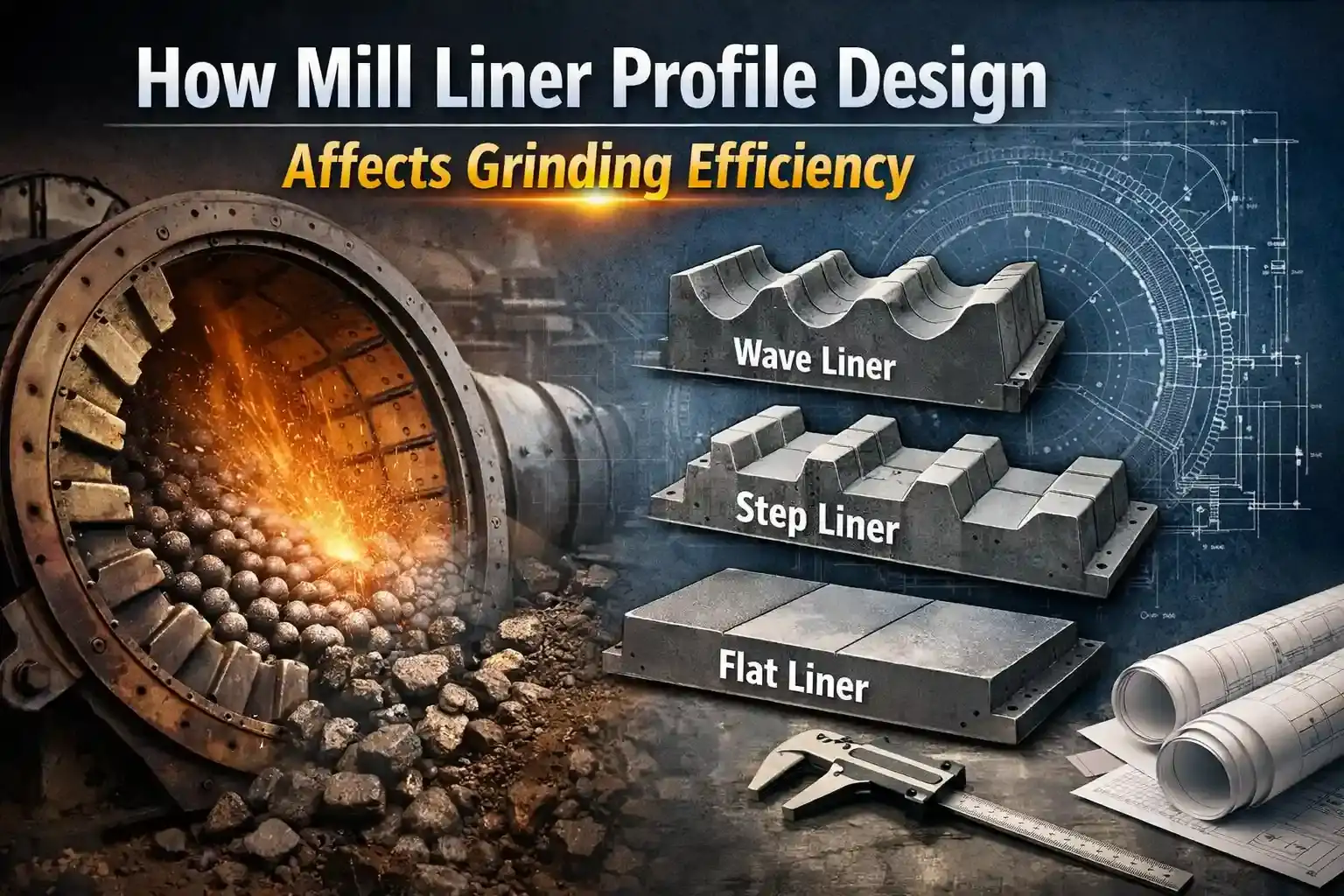
Every day, your ball mill consumes vast amounts of energy and steel to transform ore into valuable concentrate. Yet one of the most influential factors in this process: the liner profile is often overlooked by operators to focus on other aspects of machinery. As an operator, understanding how liner design impacts grinding efficiency is not just technical knowledge. It is a direct link to improving plant profitability.
The dual role of mill liners is simple yet crucial: protect the mill shell from wear while effectively transferring energy to the grinding charge . The shape of your liners determines how balls are lifted, how they cascade, and ultimately, how efficiently particles are broken. A poorly chosen or worn liner profile can silently drain millions of dollars in lost production and increased costs.
The Lifting Action
The core mechanical function of a liner profile is to lift grinding media to the correct height. As the mill rotates, liners act as lifters, carrying balls upward. The liner profile's face angle determines the point at which balls are released and how forcefully they drop down.
• Steep face profiles create high trajectories with forceful dropping, effective for impact breakage of coarse particles.
• Shallow profiles make cascading and rolling easier which is better suited for abrasion and fine grinding.
The challenge? A profile designed for maximum output may have a shorter liner life. So for peak productivity you need to find a balance that maximizes overall value .
The Wearing Out Problem
Here's the critical insight for new operators: mill liners change shape as they wear out, and performance changes with them . A profile that delivers highly efficient grinding in month one may be underperforming by month six. The Climax Mining case makes this issue pretty clear. Their S-100 single wave liners produced excellent tonnage during the first third of their life, but as wave tops wore down, grinding ability diminished until performance approximated the lower-yield shiplap design .
Key Takeaway: You're not managing a single mill liner profile; you're managing a continuously evolving one that changes shape as it wears out
How the Liner Shape Enhances Productivity: What the Numbers Tell Us
The data on liner optimization is compelling. Consider these documented improvements:
|
Metric |
Improvement Achieved |
Source |
|
Mill throughput |
+10-20% production increase |
Expert reviews across multiple mines |
|
Liner life |
+50% or greater |
Applied across many mills |
|
Mill capacity |
+16% throughput |
Barrick Cortez implementation |
|
Tonnage increase |
+3 tons/hour |
Improved liner design |
|
Liner wear rate |
18% reduction |
Double Wave design vs. shiplap |
The Cost of Getting It Wrong
The financial implications of a low-quality liner design can make the whole operation costly. The world-renowned mineral researcher Malcolm Powell's work at the Pustynnoye mine in Kazakhstan proved that a liner redesign achieved both 50% longer liner life and 20% higher mill throughput . For a single large mill, liner optimization can deliver annual savings of $300,000 to $1.5 million .
Conversely, poor design choices create hidden costs like;
• Increased operating work index (you're consuming more energy per ton ground)
• Frequent relining (that kind of maintenance means lost production time and labor costs)
• Reduced recovery (poorer grind size means less metal extracted downstream)
Section 3: Real-World Case Studies
Case Study 1: The Double Wave Breakthrough
Climax Molybdenum's 13' x 12' overflow ball mills provide one of the industry's most documented liner comparisons . Over a five-year test series, four liner profiles were evaluated:
• Shiplap design: Low lift, spinning/rolling effect on balls, diminishing performance as wear progressed
• Climax Double Wave: Outclassed the old design in efficiency as well as service life. The results were phenomenal: 18% lower wear rate and approximately 500 hours longer life
• S-100 Single Wave: Superior initial performance but deteriorated to match Double Wave average over 18-month life
The lesson? Initial performance is important, but consistent performance across the liner's life matters more.
Case Study 2: When Steep Liner Faces Backfire
At Newmont's Peñasquito operation, a bi-directional liner with a steep lifter face angle limited safe operating speed, resulting in below-target throughput. The fixed reline schedule and aggressive design meant that lifters still had plenty of life when changed out—excessive steel waste and lost opportunity
Case Study 3: End Liner Design Innovation Pays Off
A redesign of Aerofall SAG mill end liners delivered dramatic performance improvement: throughput increased from 441 to 465 t/h, product size decreased, and liner life improved by 50-200% depending on location. Relining time dropped by 37.5% .
Recognizing Performance Changes
As liners wear, the mill's behavior changes. Train yourself to identify these signs:
1. Power draw fluctuations--This is a key indicator of charge motion changes
2. Product size changes-- Finer or coarser discharge suggests altered breakage mechanisms
3. Mill noise--Experienced operators can hear when the charge trajectory shifts
4. Throughput variations--Changes in tonnage at constant feed rate
Understanding the Trade-Offs
|
Liner Design Variation (By Purpose) |
Result |
Downside |
|
For Maximum throughput |
Aggressive lift, high cataracting |
Faster liner wear |
|
For Maximum liner life |
Gentle lift, controlled trajectory |
Lower peak throughput |
|
Balanced |
Optimized over liner life |
May not maximize either extreme |
The best choice depends on your operation's economics. Is your bottleneck upstream or downstream? Is downtime your greatest cost, or is production?
Modern Design Capabilities
Gone are the days of guessing liner performance manually through visual inspection. Today, Discrete Element Method (DEM) simulation allows engineers to model charge motion, predict wear patterns, and optimize mill liner profiles before casting a single liner . These software tools can predict liner profile evolution with time and correlate it with grinding rate, providing a powerful means to balance life and performance .
The liner profile in your ball mill is really important for long-term performance. Its geometry determines how energy is transferred, how smoothly and easily the product moves throughout the setup and ultimately, how efficiently ore is ground. The data and case studies present a clear picture: a suitable liner shape can deliver 10-20% throughput gains, 50% longer life, and annual savings in the millions.
Understanding how liner design affects performance isn't just technical knowledge. It's the foundation for making smarter operational decisions. When you can explain to your supervisor why the mill power is trending down and what it means for liner wear, you're not just an operator but a problem-solver contributing directly to plant profitability.
The best liner design is the one that balances initial performance, sustained efficiency, and wear life. And the best operators are the ones who understand that balance.
Every day, ball mills do hard work. Liners in each mill ensure that the shell is not damaged by c
READ FULLOne overlooked factor in
READ FULL

Have a question or need a quote? Fill out this form and our team will get back to you quickly!