




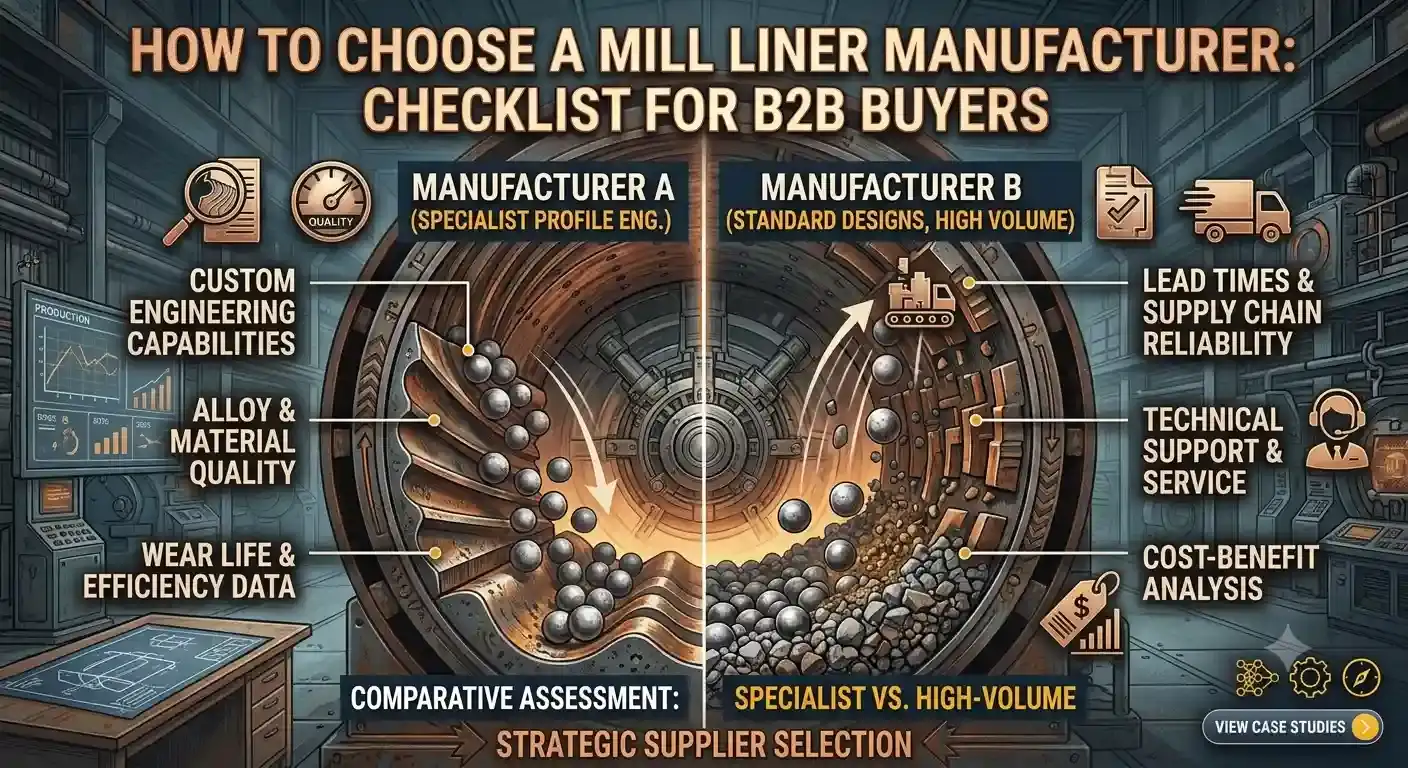
Mill liners protect grinding mills from wear and impact damage. The key to your mill's durability and replacement costs is the choice of manufacturer. Several suppliers are available, and choosing the right one can be confusing. This checklist explains all the key considerations B2B buyers should consider when dealing with a mill liner creator.
In the mining and mineral processing industry, the interior of the grinding mill is lined with mills. They help protect the mill shell from repeated impacts and abrasion. If liners of poor quality are used, they tend to wear out quickly, resulting in unnecessary downtime and liner changes. This has a direct impact on production volume, operating cost, etc. These are minimized by selecting from a trusted manufacturer. Good liners improve life and consistency, and reduce mill-interruptive maintenance throughout the mill's operating cycle.
Unplanned stoppages at the mills also impact other production timelines. If a mill unexpectedly closes, it can also cause delays to other processing steps downstream. This, in turn, affects the whole operation rather than merely the mill.
Inquire about the manufacturer's experience in making mill liners. Anyone with general metal casting skills is not a specialist in liner manufacturing.
A good ore manufacturer is familiar with the various types of ores and mill conditions. This information enables them to suggest appropriate materials and designs for the liners. This practical knowledge may be lacking in new or inexperienced suppliers.
Mill liners are typically constructed of high manganese steel, chrome-moly alloys, or other abrasion-resistant materials. Selection of material will depend on the type of mill and the hardness of the ore. Discuss the materials the manufacturer specializes in and explain why certain alloys are suitable for your application.
Various alloys respond differently to different levels of impact and abrasion. An understanding of those differences by one of the manufacturers can help direct buyers to the most economical material for their particular mill environment.
Understanding Casting Standards
Liners' strength and durability are affected by the casting process. The liner tends to weaken over time if it has many internal defects caused by poor casting. Talk about quality control for casts, such as testing whether they crack or are not uniform.
Good manufacturers provide certification documents and test reports for their products. These are hardness tests, chemical composition tests, and dimensional accuracy tests. These reports verify that liners meet the specified expectations until they arrive at your mill. Be sure to obtain sample testing reports before committing to a large purchase. This step helps to minimize the possibility of having variable quality with different batches.
Customization is important since mills come in different sizes and speeds and have different ore-processing requirements. The standard liner layout may not always meet the exact requirements of your application, leading to faster wear and reduced efficiency.
Yes, customization is possible with most experienced manufacturers. This includes Liner Shape, Thickness, and Material determined by your Mill specifications. Check this together at the beginning of your supplier negotiations.
Do a production check-up before accepting any manufacturer. It involves the number of liners they can manufacture in a particular amount of time, as well as their ability to repeat the order. A manufacturer with limited production capacity might not be able to provide you with a continuous supply. This is particularly true for buyers with more than one mill or large-scale operations. If the supplier cannot keep pace with business growth, these supply gaps can impact long-term planning.
Checking Lead Times
Lead time indicates how quickly the liners are delivered when needed. Ask about the expected production dates and shipments. A reliable supplier will offer clear estimates and always adhere to them.
While it is advisable to make some price comparisons, lower is not always better. Less expensive liners tend to have inferior materials and require replacement more often. This can lead to higher costs over a longer period, even though the initial price is low.
Request a full cost breakdown, including customizing costs, casting method, and material grade. This makes it easy to compare values and accurately reflect each supplier's true level.
A manufacturer that provides continuous customer support brings longer value beyond the products sold. This is particularly crucial for mills with specialized liner designs that require expert troubleshooting.
Yes, great after-sales support does correct the problems promptly. This includes technical assistance, replacement parts, and installation instructions. Weak support can lead to prolonged downtime during issues.
Request references from prospective suppliers from other mining or processing firms. Talking to current customers provides accurate information about product effectiveness and service reliability. Generally, a factory with a good reputation is a better long-term partner.
Reviewing the Online Reviews and Trade Platforms
The buyer rating and transaction history are usually shown on trading sites. The information, along with direct references, can help you build a better profile of a supplier's reliability before you purchase their product.
In general, mill liners are large and bulky, requiring extra care in shipping. Ask about experience with international shipping and packaging from the manufacturer. This can be particularly crucial if the buyers are importing liners from a faraway distance. Inquire if the manufacturer will do the export paperwork and customs. This decreases the chances of transactions being delayed upon import into your country.
When ordering a large quantity, go to the manufacturer's factory if available. This will allow for the production quality, equipment, and working conditions to be seen. If traveling isn't an option, then get a live video tour. This step offers assurance and validates the manufacturer's claims, proving their manufacturing capabilities.
Be sure to read the fine print regarding payment terms. Some reliable manufacturers will accept payment in advance for partial orders and then collect the remaining amount before shipping. Stay away from suppliers that require a full up-front payment and offer no guarantees. This clear communication prevents any issues while handling the business transaction.
There are multiple considerations when choosing a mill liner manufacturer. By comparing supplies, requesting documentation, and monitoring for customization, the buyers are able to make informed choices. When buying supplies, buyers compare options, request documentation, and monitor customizations to ensure they make the right decision.
The correct manufacturer can minimize downtime and maximize overall efficiency when it comes to mining and processing.
1- What is the best place to purchase mill liners wholesale for commercial use?
Buy directly from the manufacturer; they take bulk orders. This typically leads to better pricing and a consistently high product quality for large orders.
2- How to purchase a mill liner in bulk without investing a lot of money?
Compare prices for several manufacturers and inquire about expected wholesale rates. The greater the quantity ordered, the lower the cost.
3- What mill liner suppliers are there that provide customization services as well?
Search for manufacturers that have their own engineering and casting staff. Many provide customizations based on the mill size, ore type, and operating conditions.
4- Does any mill liner supplier supply bulk or custom mill liners at a low price?
Yes, several manufacturers offer bulk and tailoring packages. Speak with suppliers one-on-one about the requirements of your project.
5- What is the average lifespan of mill liners?
The life of the liner will vary based on material, ore hardness, and mill usage. Normal operating conditions for most liners are several months to a few years.
Every day, ball mills do hard work. Liners in each mill ensure that the shell is not damaged by c
READ FULLOne overlooked factor in
READ FULL
Have a question or need a quote? Fill out this form and our team will get back to you quickly!