



Industrial operations have to be cost-effective and efficient in order to achieve desired results. These results are unachievable unless they make a smart selection of materials, components, etc. Ball mill liners are among the key components that are mandatory for the protection of mills’ shells. Also, these liners contribute to the milling process by supporting the impact from milling balls to crush ores, limes, cement, etc. The confusion starts when the material selection for ball mill liners starts. There are lots of materials that contribute to the success factor of mill liners, and we will compare two of them in this blog. Industries that are confused between cost and performance need to have a look at this information. Experts already know the answer, but inexperienced professionals need a guide for it.
It is one of the two main metallic ball mill liners. Manganese contains mostly steel and a small percentage of manganese and other metals. Steel and manganese contribute to high strength in these liners, and you will get a better idea once you have a look at these specifications.
The structural strength is what defines the success factor of manganese steel ball liners. The structural strength is phenomenal when it comes to the hardening process. Manganese steel liners harden over time to improve their performance against high-impact applications. They are the best when it comes to high impacts continuously. This is why their durability is also one of the highest. When it comes to large-impact grinding, manganese steel liners lead the way.
The initial cost is high because of the use of steel, manganese, and some other metals. Steel is the largest cost factor in it. If we compare it with rubber, its initial price and installation cost are higher than those of most materials. Its replacement cost is also higher than rubber, but we can consider it cost-effective in high-impact applications.
Manganese hardens over time, which shows its high crack resistance. Among the metallic types of mill liners, it is the best when it comes to crack resistance. In extreme heat and pressure, industries prefer to use it over any non-metallic type.
However, it is not a good choice when it comes to wet milling. Its corrosion resistance is not good, which means it is not a suitable choice compared to other metallic ball mill liners. Even if we compare it with rubber, only in the case of light balls can rubber mill liners be suitable.
Yes, they are weldable. Their replacement process includes welding, which gives them additional durability. Also, they are not easy to remove if they face severe damage, so, maintenance teams go for the welding process.
Manganese liners are compatible with all sizes of grinding balls. They are the best choice when mills need large balls for the grinding process. Their high impact resistance and durability make them an ideal choice for all sizes of grinding balls.
Then we have non-metallic ball mill liners. These liners are made of NR/SBR (natural and synthetic rubbers). How they survive in a ball mill is through their high cushioning, flexibility, and other characteristics. Find out all of them in the following sections.
Rubber ball mill liners are soft in nature, which makes them one of the most compatible choices in some grinding operations. Not all milling processes need metallic liners in the milling machines. Their structural strength is good enough to withstand light impacts for soft materials.
If we compare their initial price and maintenance cost, both are lower than metallic and the rest of the materials used in mill liners. The price, installation cost, and maintenance are the most budget-friendly for mill owners. Because of their extremely lightweight structure, less labor cost and effort are required.
Rubber ball mill liners neither have any risk of cracks nor corrosion. They have high flexibility, which prevents any risk of cracking. Also, their non-metallic nature makes them naturally corrosion-resistant. They are suitable for wet grinding because they have no risk of corrosion. Unlike manganese, these liners can continuously face wet conditions without any chance of corrosion.
No, rubber ball mill liners are not weldable. If they face any damage, they need a full replacement. Manganese liners are expensive, and they are hard to remove, so they are welded in the maintenance method.
Rubber ball mill liners are compatible only with small balls and with soft materials. They are suitable for lime, talc, cement, and similar soft industrial materials for grinding. Therefore, a small size of grinding balls is enough for them.
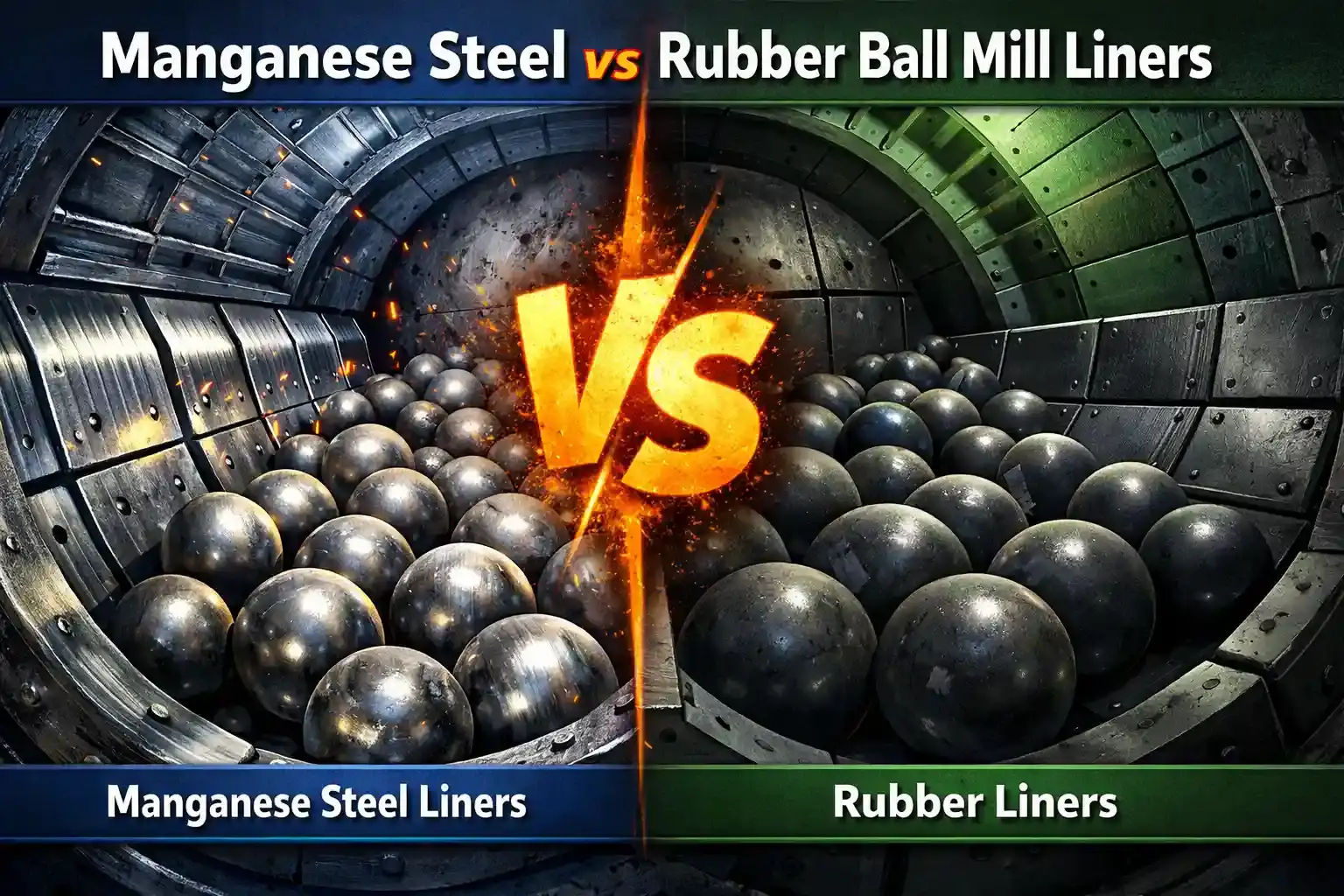
Ball mill liners are of different materials and sizes. One has to look at their compatibility with what they are milling and what the conditions are. If we compare manganese and rubber ball mill liners, they have lots of differences. Their cost, strength, durability, and compatibility are completely different from each other. So, here is the conclusion: if it is about heavy-duty milling, dry conditions, crack resistance, and durability, choose manganese steel ball mill liners. If it is about light milling, wet conditions, and low-cost liner material, choose rubber ball mill liners.
Where Can I Procure Weldable Ball Mill Liners from?
Source weldable or manganese steel ball mill liners from Ningguo Ningwu Advanced Material Co., Ltd. This manufacturer has budget-friendly prices and worldwide supply.
Are Manganese Ball Mill Liners Suitable for Wet Milling?
No, they are prone to corrosion, which means they are not suitable for wet conditions.
Are Rubber Mill Liners Suitable for Large Grinding Balls?
No, they are suitable only with small ball mills and soft materials like lime, cement, etc.
Do Manganese Ball Mill Liners Enhance Their Hardness Over Time?
Yes, manganese ball mill liners enhance their hardness over time. You can source high-grade manganese ball mill liners from Ningguo Ningwu Advanced Material Co., Ltd.
Every day, ball mills do hard work. Liners in each mill ensure that the shell is not damaged by c
READ FULLOne overlooked factor in
READ FULL

Have a question or need a quote? Fill out this form and our team will get back to you quickly!