



The liner wear rate is an active operational cost that dictates your plant’s energy consumption, and ultimately, its competitive standing in the market. Your decisions on when and how to address liner wear directly influence whether your plant operates at 92% availability or limps along at 78%. That 14% gap is the difference between meeting quarterly targets and explaining budget overruns to senior management.
This guide will move you beyond the generic “change it when it looks thin” approach. We are giving you the forensic tools to analyze why your liners are wearing and the tactical strategies to extend their life without sacrificing throughput. Your rivals at other plants are learning this. The question is: will you?
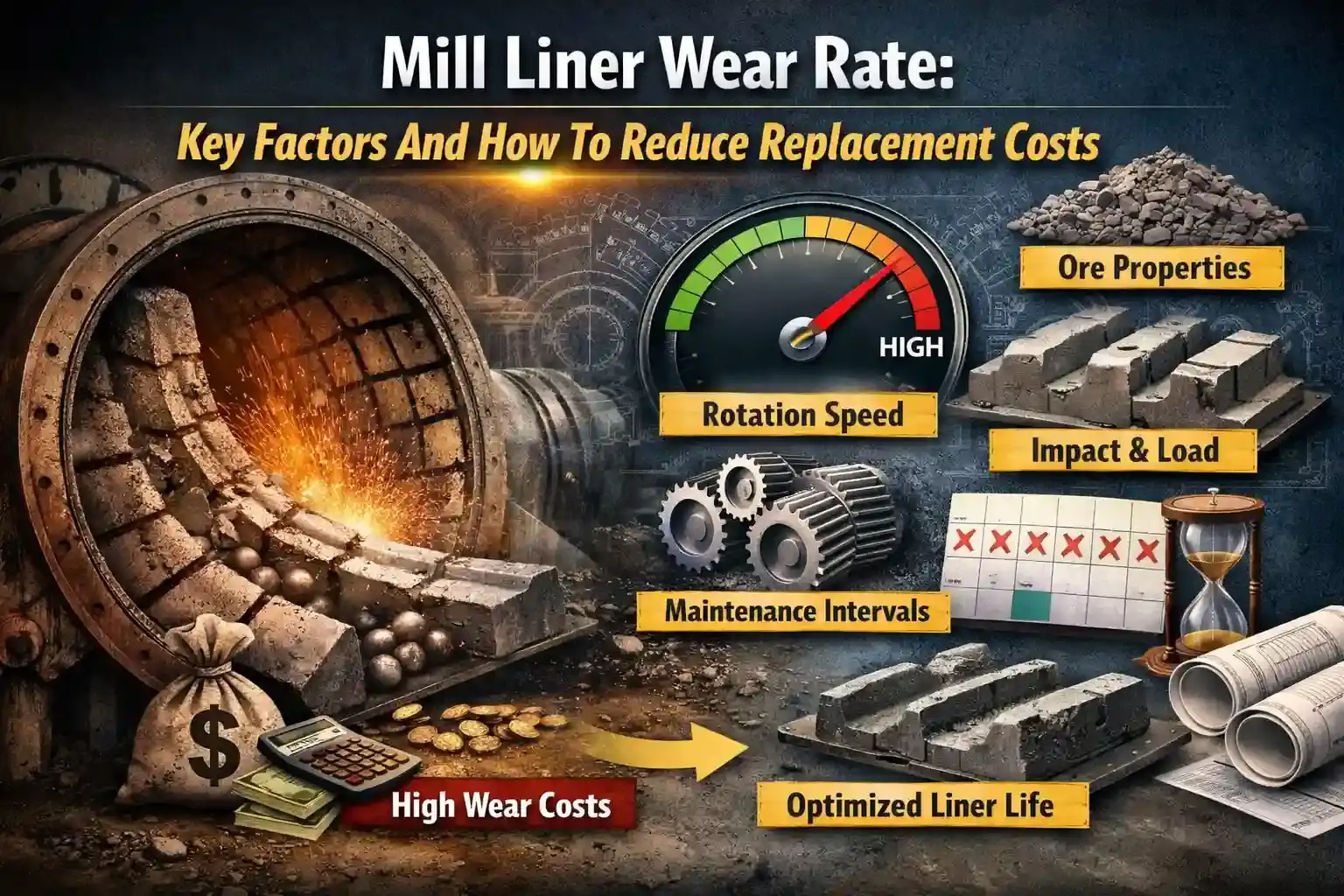
To reduce costs, you must first understand what factors are driving it. Wear is not a single phenomenon; it arises through a mix of physics, chemistry, and operational choices. The blunder that maintenance professionals make is treating the liners as passive steel components. Treat them as sensors that tell you exactly what is happening inside the mill.
Why this matters more than you think: Every ball drop is a micro-impact. Every sliding ore particle is a micro-abrasion. But here is the critical distinction—impact and abrasion damage liners in entirely different ways, and you need to diagnose which is dominant in your ball mill.
Impact causes fatigue cracking and breakage. It is the sudden, violent force that chips lifters and creates stress fractures. Abrasion, on the other hand, is the relentless frictional force that reduces shell plate thickness silently and slowly. If you are applying an abrasion-resistant liner to a mill setup that is losing productivity from impact wear, you are prescribing the wrong solution and wasting maintenance budget. The importance here cannot be overstated: misdiagnosing the primary wear mechanism can shorten liner life by 40% or more. That is not a minor inefficiency; that is a budget catastrophe.
Speed is not just a setting on your variable speed drive it accelerates the rate of wear as well. Higher mill speed increases the centrifugal force, which in turn increases the sliding velocity of the charge against the liner surface. A 5% increase in mill speed can result in a 15% increase in wear rate.
Why this matters:
Because operators often chase throughput by increasing speed, unaware that they are simultaneously accelerating liner degradation.
The ore you process is not just feed. It has an abrasive surface that dictates liner life. Hardness, size distribution, and physical characteristics of the feed are the primary determinants of your wear rate. A feed with a Bond Work Index of 20 vs. 14 doesn’t just require more power—it requires significantly more liner steel.
Why this matters:
If your feed hardness has increased and you have not adjusted your liner alloy or your inspection frequency is lacking, then you are heading for disaster. You must link your mine’s ore hardness reports with your liner wear logs. If they do not match your maintenance strategy is guesswork, and guesswork is expensive.
Slurry density is the overlooked factor in wear management. Too thick slurry and the slurry cushions the impact, reducing wear. This is good but the downside of lowered output cancels out the good. Too thin a slurry and the water accelerates corrosion and creates a highly abrasive slurry that strips liners bare.
The Solution:
There is a narrow range for slurry density, usually between 65% and 75% solids by weight. This consistency minimizes wear while maximizing grinding efficiency. Falling outside this range increases wear rates by a large margin. If you are not monitoring slurry density every shift, your liners are paying the price.
Not all liners erode out at the same pace. Lifters, which grip the charge and create the cascading motion, wear at a different rate than shell liners, which protect the mill body from direct impact. So replacing all liners at the same interval is a mistake. You are either changing lifters too early (wasting good steel) or shell liners too late (risking mill body damage).
You can have the perfect alloy, the flawless speed, and the correct feed, and still suffer catastrophic liner failure due to mechanical negligence.
The Bolt Issue: More Than a Fastener
Liner bolts are not passive hardware component. They are the structural connection that holds your mill’s protective armor in place. When bolts loosen overtime the liners begin to move independently of the mill shell. This movement creates micro-fretting, which accelerates fatigue cracking at the bolt holes. Why this is critical: A single loose bolt can compromise the integrity of an entire liner section. That section will then flex and move with every mill rotation, creating stress concentrations that lead to premature cracking and breakage. The result? You are forced to change a liner section that had 60% of its useful life remaining. The financial impact is enormous, and it is completely preventable.
Many technicians) measure the wrong spot. They walk the mill with a thickness gauge, find the thinnest point, and declare the liner ready for change-out. But that thin point may be a localized anomaly—a high spot from a casting defect or an area of concentrated impact. Why this matters: Replacing a liner based on the thinnest local measurement means you are discarding the remaining 80% of the liner that still has serviceable thickness. This is the single most common cause of unnecessary liner replacements.
The “Smart Rotation” Strategy
Not all zones in a mill wear out at the same rate. The feed end, where ore enters, experiences higher abrasion. The discharge end often sees more impact. The center sections may wear at a moderate rate.
The urgent action: By rotating liners from high-wear zones to low-wear zones at the halfway point of their life, you can extend the average life of the entire set by 20-30%.
Doing this is not difficult. You simply need meticulous tracking and a willing crew. A liner that would last 12 months in the feed end and 18 months in the discharge end can both be extended to 15 months with strategic rotation. That means fewer change-outs, less downtime, and lower procurement costs. Your competitors are doing this. If you are not, you are leaving money on the table.
How to Implement this:
Create a simple spreadsheet that tracks wear rate per ton of ore processed. This kind of recordkeeping will transform your maintenance from reactive to predictive. You will know, within a week, when your liners will reach critical thickness.
Stop using a “one-size-fits-all” spec. Your ore is unique, and your liner material should reflect that.
The High Chrome vs. Rubber vs. Composite Debate
High chrome liners offer exceptional abrasion resistance but are brittle and can crack under high impact.
Rubber liners excel at impact absorption but wear quickly in abrasive environments. Composites combine elements but come at a premium price.
Why This Matters: Choosing the wrong material for your specific ore can shorten liner life by 50% or more. If your ore is high-impact (coarse, hard rock), high chrome may be a disaster. But if your ore is highly abrasive (fine, silica-rich), outfitting with rubber is just budget wastage. You must understand your ore’s characteristics and select accordingly.
The ROI of Premium Alloys
Spending 15% more on a premium alloy that lasts 30% longer means that you win. The math is simple. If a standard liner costs $100,000 and lasts 12 months, your cost per month is $8,333. A premium liner costs $115,000 and lasts 16 months and cost per month drops to $7,187. Add in the savings from reduced downtime and fewer change-outs, and the ROI is undeniable. Why this matters urgently: Many plants continue to purchase the cheapest liners available, mistaking upfront cost savings for operational efficiency. That is a costly illusion. The smart plants invest in the right material and reduce total cost. Which category does your plant fall into?
Stop guessing: Start measuring with precision.
Visual inspection has become outdated. The human eye cannot see stress fractures beneath the surface. Visual inspection is subjective, error-prone, and often delayed
Ultrasonic thickness gauging allows you to map the remaining material with millimeter accuracy. You will know the exact wear rate, identify thinning zones early, and predict failure within 5% accuracy. The importance: This is not optional. If your plant is not using ultrasonic gauging, you are operating in the dark. Your competitors are using it. They are optimizing their change-out schedules while you are still squinting at liners with a flashlight. The gap is widening.
Liners are not efficient because of a solid material build. They are efficient through predictive maintenance. And that maintenance translates to consistency, which in turn gives better throughput. Throughput means you beat the plant’s average tonnage. And beating the average shows the success of the maintenance team.
Do not wait for the liner to fail. Walk your mill with a critical eye today. Approach your supervisor and ask for the last six months of wear data. If they do not have it, you now have a golden opportunity; you can be the one who creates it.
Every day, ball mills do hard work. Liners in each mill ensure that the shell is not damaged by c
READ FULLOne overlooked factor in
READ FULL

Have a question or need a quote? Fill out this form and our team will get back to you quickly!