



Ball mills are used to grind materials into fine powder. Liners are used to safeguard the inner wall of a ball mill. Liners also regulate the movement of the grinding balls. There are two liner profiles commonly used: the wave liner and the lifter bar. They have different characteristics and operate differently. Selecting the right can make grinding more effective and cost-efficient. This guide details the difference in simple terms.
A ball mill liner is the protective layer of the ball mill. It is located between the shell and the grinding balls. If not lined, it would wear out quickly. Another function of liners is to lift and move grinding media. This movement achieves the actual grinding of the material.
The design of the liner affects the ball's motion inside the mill. A few shapes carry up the balls before letting them fall. Other shapes cause a rolling motion. This directly impacts grinding speed and energy consumption. If a wrong profile is chosen, it will waste power and reduce production. Thus, the liner is not only used for protection. It is an important factor in the day-to-day operation of the mill.
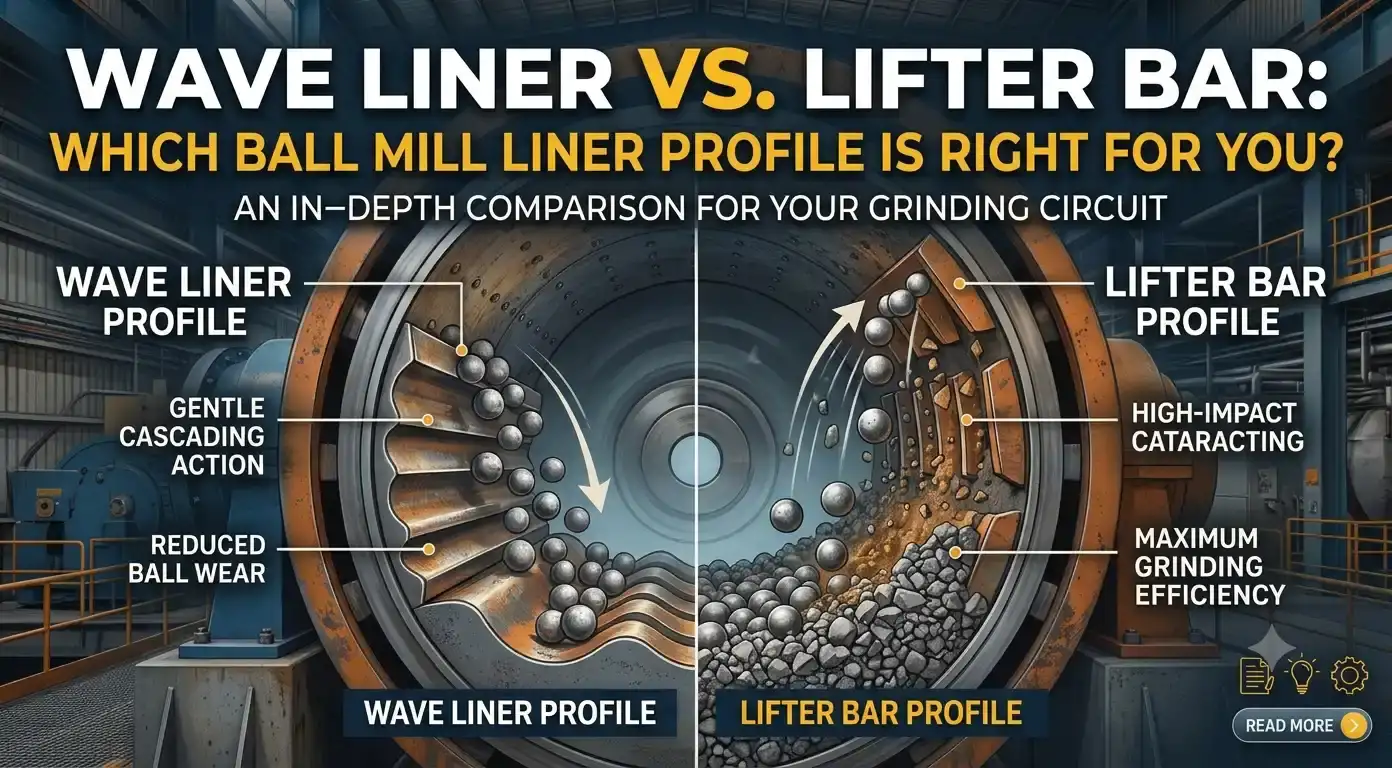
Wave liners have a smooth, wave-like surface. The waves are not sharp corners, just curves. This design causes the mill to perform a rolling and cascading action inside. Balls do not rise sharply but follow a smooth path. Wave liners are frequently used in fine grinding operations.
They work well with smaller balls.
There are several reasons why certain grinding jobs can use wave liners. The smooth motion helps to prevent cracks and breakage on balls. Balls don't hit the shell with too much force. This is to reduce noise while running. Wave liners also have a longer lifespan. There are no sharp edges, resulting in more even wear across its surface.
Wave liners are not ideal for all situations. They are not as good with really large balls. Eventually, larger balls will require a heavier lifting motion to grind. Wave liners may not provide enough impact force for coarse grinding. This implies that difficult materials may require slower production speeds. The improper selection of wave-liners can negatively affect mill efficiency.
Lifter bars are additional risers attached to the inside of the mill. They have a good lifting effect on a grinding ball. Balls are propelled higher before falling back down. This will make their landing feel greater. Mills that require high crushing power often have lifter bars.
Coarse and hard materials can be processed using lift bars. The strong impact disintegrates large particles more quickly. This is because lifter bars are well suited to the primary grinding stages. They also perform better with larger ball sizes than wave liners. This is why many mining and cement businesses like lifter bars.
Lifter bars do, however, have disadvantages. There is a strong impact that can lead to quicker wear of balls and liners. The higher the impact, the noisier the machine will operate. There is a potential for higher ball breakage rates than with a wave liner. Higher maintenance expenses can result from increased liner change-out frequency. This increases the cost of lifter bars over time in some instances.
In fine grinding applications, it is often better to use wave liners. They move smoothly, well-suited for the smaller balls and delicate materials. Lifter bars aren't suitable for very fine grinding.
Both of these liners have the same fundamental function. However, they act very differently in the mill. Wave liners make the waves smoother and more rolling. Lifter bars provide a more powerful lifting action. Waves liners are for fine-grinding. Lifter bars are suitable for coarse grinding. Wave liners tend to be longer lasting. Lifter bars tend to last less time but can break harder material faster.
Ball size is an important factor to consider when selecting the right liner. Wave liners are best for smaller balls. The bigger balls require more lift from lifter bars. Grinding efficiency reduces if the ball size is not compatible with the grinding liner project. This may result in increased energy bills and reduced productivity. Before making your choice, always match the size of the ball to the type of liner.
Another factor to consider is the content of the material being ground. Waveliners are good to use on soft materials such as limestone. Lifter bars may be required to handle hard materials such as ores. Some mines even employ a combination of both liner types in various parts of the mill. For efficiency and durability, this hybrid strikes a good balance.
Yes, indeed, mill size plays an important part in choosing the right liner. If more force is required, lifter bars are used in larger mills. Smooth wave liner designs might be more suitable in smaller mills.
Another significant factor is using energy. The wave liners tend to use less energy because they enable smoother ball movement. There's a stronger lifting action, which means more power can be used with lifter bars. Lifter bars, however, can complete more coarse grinding jobs more quickly. This is because the total energy consumed and the energy per ton of material may differ. Always make an energy cost estimate before finalizing the deal.
The liner's maintenance influences the overall running costs. There are fewer times they need to be replaced with wave liners. A smooth wear pattern helps prolong the liner's life. Lifter bars wear faster due to constant heavy impact. This will lead to more frequent changeouts and higher long-term maintenance expenses. Consider any of these expenses when determining whether one option is more valuable than the other.
The two lining types have different noise levels. Wave liners operate quietly because of the gentle movement of the balls. Strong lifting movements produce more impact noise with lift bars. Some areas may be subject to workplace noise regulations. It is always best to refer to safety teams if sound is an issue.
Wave liners and lifter bars aren't always easy to choose between. Each mill operates in its own unique way. Communicate with your equipment supplier about the grinding requirements. Provide information on the material type, ball size, and mill capacity. A responsible supplier will suggest the optimal liner profile to back you. They could even recommend trying both variants before deciding which one to choose.
Not all operations select a single type of liner. Some places install wave liners; others install lifter bars. This combination technique provides both smooth grinding and good impact force. It is suitable for mills with other material dimensions. Speak with your manufacturer about this hybrid solution if you require extensive grinding time.
Wave liners and lifter bars are crucial components within ball mills. Wave liners work well in fine grinding, with smaller balls, and quieter operation. Lifter bars are suitable for coarse grinding, large balls, and high impact force. This is based on the type of material, ball size, and mill size. When choosing, always consider energy usage and maintenance. This is easier when working closely with a trusted supplier.
1- Where should I buy ball mill liners wholesale for retail sale?
Ball mill liners can be purchased in bulk directly from recognized manufacturers on sourcing platforms such as Alibaba or Made in China. Mining and industrial trade fairs are also great ways to meet directly with bulk suppliers.
2. How to Buy Ball Mill Liners in Wholesale at Affordable Rates?
When making a decision, compare prices from different manufacturers. The larger quantity purchased typically results in a smaller per-unit price. Factory rates are often more attractive than those of trading companies.
3- Where Can I Find a Ball Mill Liner Supplier Who Also Offers Customization?
You can find many manufacturers who are offering customization options according to your mill size and grinding requirements. Look for suppliers that are listed as "OEM" or "customized service". Be sure to ask directly at the time of initial contact to confirm this.
4. Can the Ball Mill Liner Supplier provide bulk supply with customization services at low costs?
Yes, there are a number of manufacturers that offer bulk supply and a customization service. Larger factories that have engineering departments in-house will offer this at a competitive cost. Getting a few quotes is best when you want the best deal
Every day, ball mills do hard work. Liners in each mill ensure that the shell is not damaged by c
READ FULLOne overlooked factor in
READ FULL
Have a question or need a quote? Fill out this form and our team will get back to you quickly!